UNIVERSITY OF NORTH CAROLINA-ASHEVILLE
LIBERAL STUDIES INTRODUCTORY COLLOQUIUM
CHEM379, Spring, 2012
The Use of Wildlands: Conservation or
Preservation
Wayne E. Steinmetz
COURSE
HOMEPAGE

This course is dedicated to George Duffy,
former wilderness manager of the
Angeles National Forest and
a devoted defender of the wilderness.
CATALOGUE DESCRIPTION
CHEM379. The Use of Wildlands: Conservation or Preservation. The course will examine in a cross-disciplinary manner arguments for the protection of wildlands. Our discussion will be informed by a close reading of classics in the area of conservation by Pinchot, Muir, Marshall, Abbey, and Leopold. The course will address the debate on conservation versus preservation. The study of the need for wilderness will touch on the larger debate on global climate change and sustainability. The course will include field work in a wilderness area of the Pisgah National Forest which will provide the basis for one of the papers. The course grade will be based entirely on class discussion, papers, and an oral presentation of the final project. Mr. Steinmetz. Spring semester.
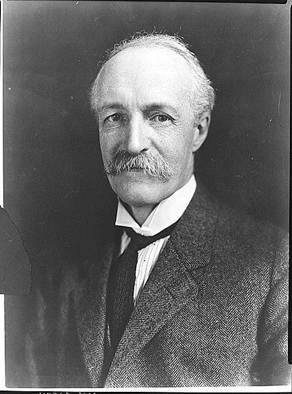
Gifford Pinchot, Conservationist and Forester
Founder of the
Source: Library of Congress
From the Wilderness Act of 1964
A wilderness, in contrast with those areas
where man and his own works dominate the landscape, is hereby recognized as an
area where the earth and its community of life are untrammeled by man, where
man himself is a visitor who does not remain.
An area of wilderness is further defined to mean in this Act an area of
undeveloped federal land retaining its primeval character and influence,
without permanent improvements or human habitation…
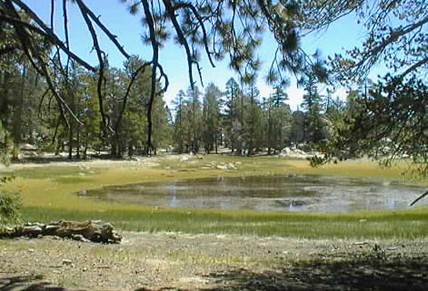
Hidden
Lake,
(taken
by WES on 18 July 1998 on a Boy Scout backpack)
You
will have an opportunity to craft your definition of Wilderness. A comparable class in 2006 at Pomona College
formulated its understanding of Wilderness.
· Wilderness is
a place that offers solitude, serenity, silence, seclusion, simplicity, and
freedom.
· In the
Wilderness, the elements of the ecosystem are in balance.
· Those who
experience the Wilderness feel at one with a greater unity and struck by the
immensity and profundity of it all.
· Some seek the
Wilderness as a place of adventure and others see it as a counterbalance to
human hubris.
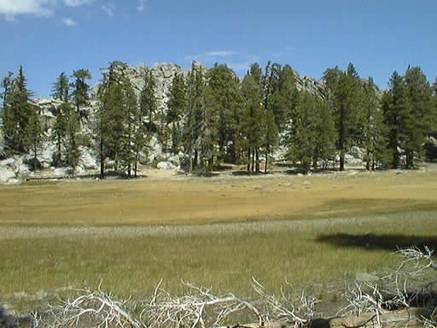
Hidden Lake,
(taken by WES on 23 August 1998)
Goals of the Course
CHEM379 deals with the wilderness and considers the
following questions.
· What is the
value of the wilderness?
· What are its
characteristics?
· How do we use
the wilderness?
· How can we
preserve the wilderness?
· What are the
tradeoffs between conservation and preservation?
This simple Web page provides links to
materials used in the course.
Course Mechanics and Resources
1.
Course handouts
b) catalogue
description of the course
c) handout on art and the wilderness
d) citation styles (prepared by the Pomona
College Writing Center)
e)
guidelines on the final paper
2.
General resources
on the WWW dealing with the wilderness
a)
The Evolution of the
Conservation Movement, Library of
Congress
b)
USFS film The
Greatest Good
c)
National
Park Service resources
e)
Maps and aerial
photographs
Google Earth (photographs)
Microsoft
Terraserver
(photographs and USGS topographic maps)
3.
Full text of
Gifford Pinchot, The Fight for
Conservation
4.
On-line version
of the Bible (Revised
Standard Version)
5. Robert (Bob) Marshall’s seminal article on need for wilderness areas: Robert Marshall, “The Problem of the Wilderness”, The Scientific Monthly, 30(2), 141-148 (Feb., 1930). A second article by Marshall on wilderness protection is Robert Marshall, “The Universe of the Wilderness Is Vanishing”, Nature Magazine, 29, 235-240, (April, 1937).
The journal was published by the American Association for the Advancement of Science and is available through JSTOR.
6. Materials on art and wilderness
a) Handout on
American art including essay by Solnit
b) Wikipedia entry on shan shui (Chinese landscape art) and Guo Xi
, a master of shan shui
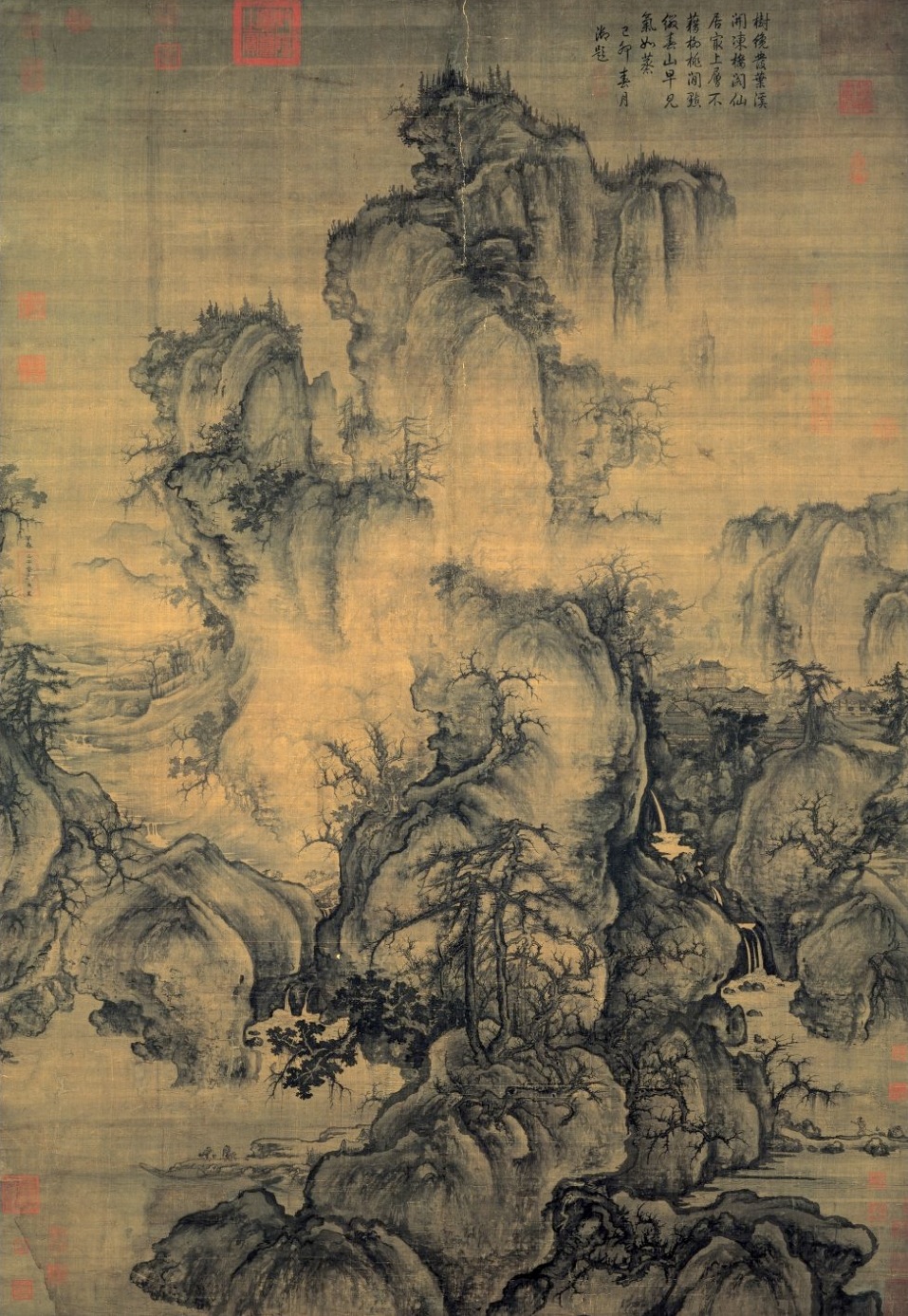
c) “Early Spring”
painted by Guo Xi in 1072, Palace Museum, Taipei, ROC
d) The Haen Gallery, 52 Biltmore Ave., Asheville, has an excellent exhibit of wilderness art. The opening hours for the gallery are Mon., Wed.-Fri., 10-18; Tues. and Sat., 11-18; Sun., 12-17.
7. WWW resources on ecology with an emphasis on North Carolina
a) Biomes of
North America, lecture notes of James Reveal, University of Maryland
b) G. B. Bonan, paper
on environmental factors, from Vol. 3 of the journal Landscape
Ecology
c) Susan Woodward, Radford University, Major
Biomes of the World
d) M. L. Corn, Ecosystems,
Biomes, and Watersheds, a report prepared by the Library of Congress for
the Congress.
e) R. C. Heath, Basic Groundwater Hydrology,
USGS Paper 2220
f) The Western Ecology Division of the US Environmental
Protection Agency (EPA) has a page devoted to the ecology of North
Carolina. The following documents
from this site are particularly useful:
i.
A map of the ecoregions of North Carolina
ii.
a map of the ecoregions of South Carolina and the
US
iii.
a tabulation of
the ecoregion characteristics of NC
g) The Wilderness Society hosts a WWW version of North Carolina
Mountain Treasures that contains information not found in the document
distributed to the class.
h) Eastern Carolina University hosts a WWW page on the Environmental
Ecosystems of North Carolina.
i) The USFS study on the Terrestrial
Ecological Characteristics of the Nantahala and Pisgah National Forests was
obtained from a Nature
Serve site.
j) The Forest Plan for the Pisgah National Forest is the
official USFS document on the state of the forest and plans for the
future. The report is very large (6 MB);
due to peculiarities of the USFS Web site, it has to be accessed
indirectly. First go to the home page
for the Forests of North Carolina. Click on Land and Resources Management in the
left-hand panel. Click on Planning in
the center panel on the next page. Then
click on Nantahala and Pisgah National Forests under Forest Plans in the center
panel on the following page. Click on
Nantahala/Pisgah Land Management Plan; Amendment 5 under Nantahala Pisgah Plan
on the next page. The pdf file of the 370-page document will open on new
window. This page cannot be accessed
directly. The report has been downloaded
and can be accessed directly from this link: Forest
Plan .
8. The Sierra Club WWW site provides links to the works
of John Muir.
a)
The
Yosemite
b) Steep
Trails
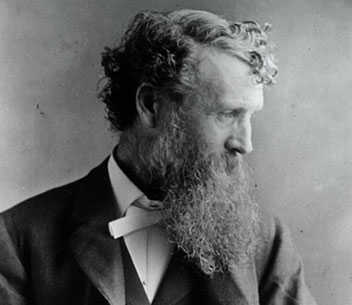
John Muir, source: National Park Service
9. Low Impact Camping (BLM site)
10. Resources on Hetch Hetchy
a) study site
maintained by the state of California
b) chapter on Hetch Hetchy in Muir’s book The
Yosemite.
c) Use Hetch Hetchy as a keyword to search for documents on the Library
of Congress Web site devoted to conservation.
11. Documents for the summary of the course
a) R. M. Pringle, “How to Be
Manipulative”, Am. Scientist, 100, 30-37 (2012)
b) G.
Duffy, Farewell Letter
12. Field trip in the Shining Rock Wilderness. A field trip on the Shining Creek Trail and
the Old Butt Knob Trail will provide data for the second paper.
a) A map of the area was
produced by the instructor using Version 10 of ArcMap,
Garmin 60Cx GPS, and shapefiles provided by the EPA. The map highlights three trails that begin at
the Big East Fork trailhead on US 276 south of the Blue Ridge Parkway: cyan,
Big East Fork Trail; maroon, Old Butt Knob Trail; orange, Shining Creek
Trail. The map shows the two dominant ecoregions for the area: high mountains (dark green) and
southern crystalline ridges and mountains (light green).
b) The wilderness manager recommends this area for its
diversity.
c) If US 276 is impassable due to snow and ice, the
field trip will be conducted in an area closer to UNCA.
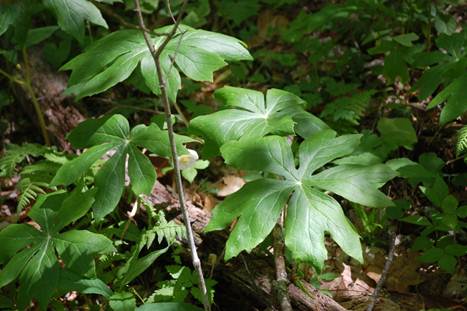
May apple seen at 3600 feet on the
Big East Fork Trail (30 April 2011)
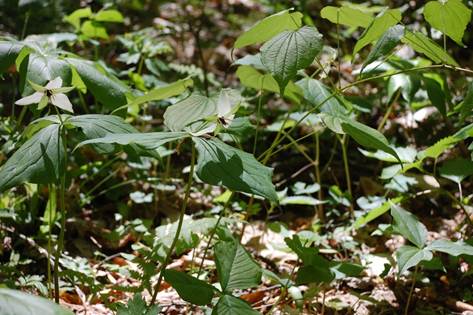
White trillium seen at 3600 feet on
the Big East Fork Trail (30 April 2011)
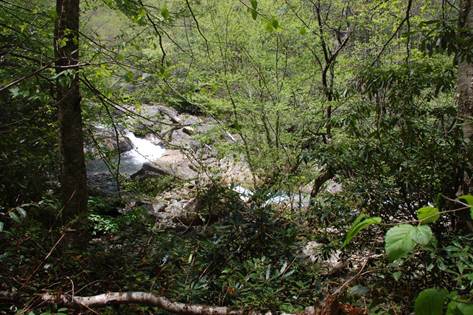
upper east fork of the Pigeon River
at 3600 feet
on the Big East Fork Trail (30 April
2011)
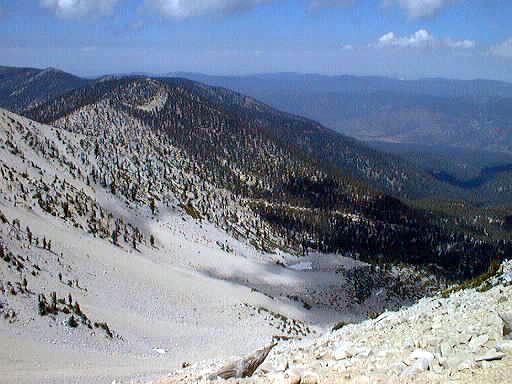
San
Gorgonio Wilderness, view north of a glacial cirque
(taken by WES at a saddle between San Gorgonio and E. San Bernardino Peaks
in
the San Gorgonio Wilderness on 1998 freshman orientation trek )
Last changed on 26 February 2012